
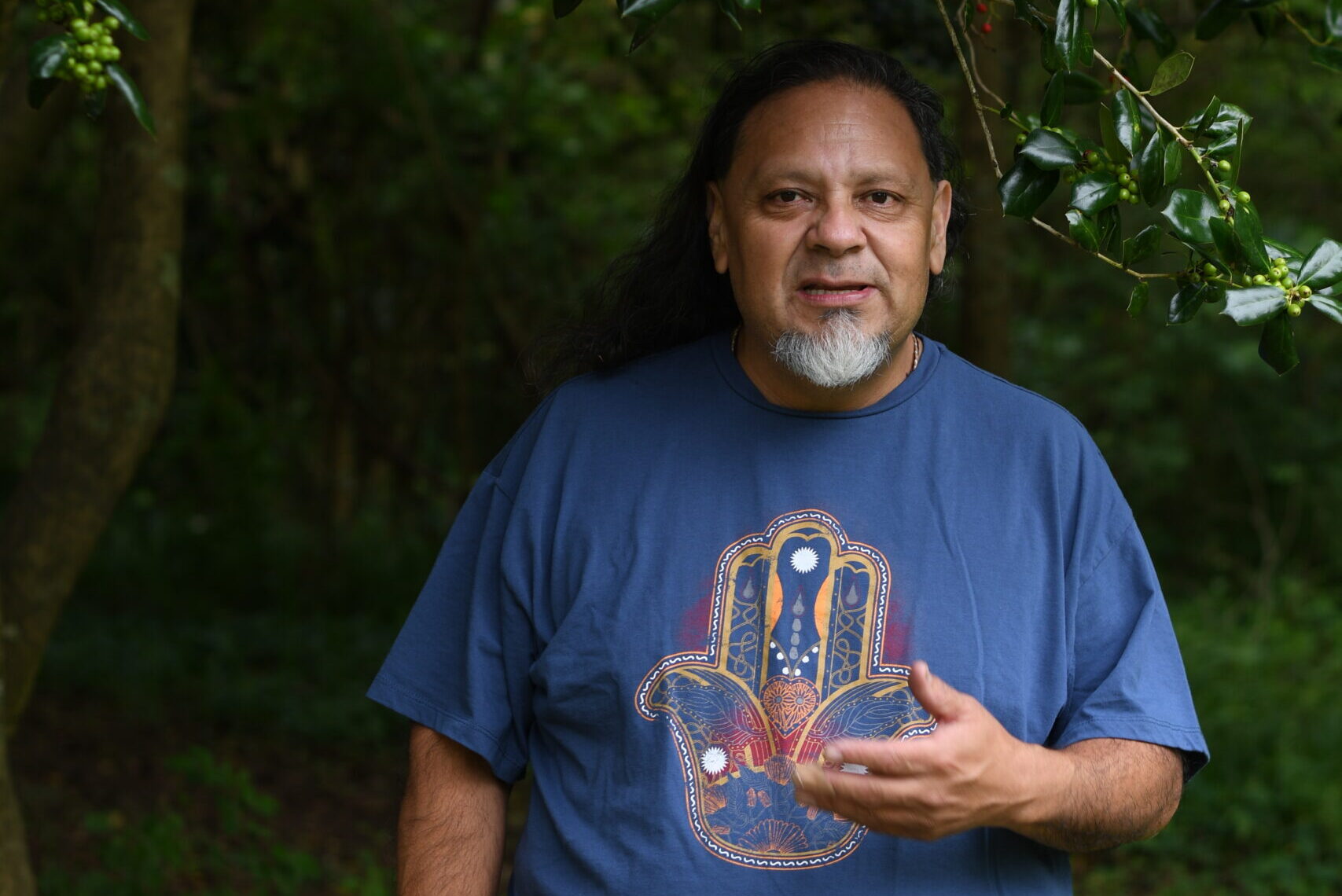
Art in action: Local activist uses art, poetry and music to create change
When Beto Cacao, a local artist, musician and activist in Athens, was a child, he encountered a huge gas explosion in San Juan Ixhuatepec, a town in Mexico, as a result of corporate mismanagement. After the disaster he experienced the ways his community advocated and stood up for their rights through protesting.
Cacao has since blended art, music and poetry together to empower individuals to express their voices and to preserve the oral histories of migrant communities and Hispanic descendants in the United States.
“These things are close to the poetry that is in our body and in our lives. That is (why) I think art has been useful to me, (kept) me alive,” Cacao said. “It’s been difficult (but) beautiful, and (I’m) learning every step of the process.”
Cacao labels this journey as liberation, because his art is a part of the process of transformation. He can empathize with the feeling of being oppressed and of the suppression of marginalized people.
“I learned that through the process (of liberation), art can be used not (only) to protest or fight for its own rights, but also to be a tool for liberation,” Cacao said. “When people ask me, ‘do you help the community’, I say, ‘No, I’m part of a process of transformation, which I call liberation.’”
Growing up, Cacao didn’t have an easy childhood. His family was poor and working class, and it was a difficult time in Mexico.
“It was a time where you walk outside on the street and you can die. It was normalized, and you have to be tough to survive that,” Cacao said.
Cacao’s family moved from Michocan to Mexico City during the 1970s. Poetry, music and art helped Cacao find safety from his painful life experiences.
“I can find beauty so I can escape the horrors of my reality. When I get into music and poetry, that is the space I use to create poems,” Cacao said. “The struggle for fighting for social justice is important, which is the tool we use to deliver our message. Art, poetry and music have these powerful tools.”
Cacao moved to Athens in 1999 to work with his brother Noe Mendoza as a mechanic. After adapting to living in Athens, he noticed the recurring problems that negatively affected the Athens community, like the Latino community worried about deportation or where to find resources and assistance.
Cacao started finding out how this affected them personally and professionally. Thus, as a way to help, he started to become more and more involved in movements, organizing and community meetings.
Becoming an activist has impacted Beto in multiple ways, but most importantly it gives him hope that the work he is doing will positively affect immigrants and members of his community.
“It gave me hope, but not this magical hope that something’s gonna happen. That hope is coming from the place where I’m doing something, that’s why I know something good is gonna happen,” Cacao said.
Cacao has performed in multiple events such as LatinxFest and in every single school in Athens, according to AthFest. While he performs, he has been able to recognize things he likes about himself.
“I never see beauty in myself but through art, people see beauty of (me). When (I’m) performing, (I’m) performing with (my) body, with everything around (me), and then little by little I’m able to be in my own body and recognize certain things I like,” Cacao said.
Through Cacao’s journey into becoming an activist, he has been able to realize how many political movements there are and understand the varieties of social changes people fight for.
“One of the difficult parts of life is thinking that we know everything. Especially for us males, we are so protected, we are so arrogant that we think that we know everything,” Cacao said. “Through (this) journey, I have to keep my eye open and to discover the otherness, because this is part of intersection. The intersectionality of the movement, where you have to recognize the other struggles, like women’s rights, children rights, segregation, racism and indigenous rights.”
As Cacao has connected more to his cultural background through the years, he has been able to recognize his roots and learn more about his heritage. This has led him to connect further with his indigenous roots, making indigenous groups an important part of his life.
“I recognize that my ancestors led me to all these beautiful things that are part of my life every day such as tamales, tortillas, and pozole, that have been here for hundreds of years,” Cacao said. “When I cook tamales with la abuelita (grandma) or with my mother, they’re full of stories and that is the way we preserve hundreds of years of traditions and knowledge now.”
Cacao has used music to uplift the stories of his culture and people for many years. His last music release was on Aug. 8, 2024, but he is also working on his new album, “Bosses del Pueblo.”
Alys William, John Brocato and Cacao recently released their new single “If They Come For Me.” They wrote the song to convey the fears and feelings of people under the administration of President Donald Trump. The music video also features how the Athens community is resisting these threats.
“Beto is an artist, activist and intellectual who puts all of his many gifts at the service of our community. He brings it all to the work, and that’s why people want to be a part of a movement with him, because there’s music, art, laughter and connection in it,” William, a local activist, said. “Hate and division just can’t stand against that.”
Cacao also recently finished writing his book “Poe Inmigrantes.” The book talks about the documented stories of the migrant community living in struggle.
“(In the book I) used the tools of poetry to deliver a message, but also to send a message that we are not only peasants. We are sentiments, and that’s what makes us human. We have access to knowledge, and we can use the tools of poetry to deliver our message and to get close to beauty,” Cacao said.
Alongside his book and music, Cacao has attended many national conventions and has been involved in many organizations outside Georgia, including groups with a presence in New Jersey, Michigan, Indiana and Massachusetts.
“I’ve been attending some national conventions, like the Social Forum for Social de Los Estados, Unidos in 2007 which was all the progressive organizations gathering in one part to dream. Back in those days, we were fighting for the Dream Act,” Cacao said.
Cacao has been involved in many organizations and groups within the Athens community. A member of Dignidad Inmigrante en Athens (DIA) and the Director of the Latinx Festival in Athens, he is mostly involved with Athens Immigrant Rights Coalition, a collection of different types of organizations such as U-Lead Athens, which is a non-profit organization that provides support for education rights.
“What we do is to enhance and protect immigrant rights in Athens and to identify those organizations who are working for immigrant rights and try to address or find the information and organizations,” Cacao said.
Barbara Benson, a retired professor at Piedmont College, has known Cacao since 2012. She has seen him perform at Historic Athens Porchfest, LatinxFest and the North Georgia Folk Festival.
“I admire Beto greatly because he always shows up for the Athens community and spreads his love to so many people from different backgrounds,” Benson said. “He cares about everyone, especially those whose voices are unheard.”


