
No stone unturned: Cedar Shoals’ renovation comes to a close
Clarke County School District renovates school buildings in its jurisdiction on a 20 year rotation. Cedar Shoals High School was originally built in 1971 and chartered in 1972, making the first renovation of the school in 2001 severely overdue.
Demolishing the main academic building quickly made up for this gap, leaving only the automotive technology building and old gymnasium standing. The new and current academic building, built across from where it was formerly, was then accompanied by a new gymnasium and two buildings dedicated to fine arts and career, technical, and agricultural education (CTAE).
With that redevelopment ending in 2004 after three years, 2024 marked the time to begin refreshing Cedar once again.
“(With) Cedar (renovated) in 2004, 2024 made it its turn to be renovated. So about a year before that, when we ran the last SPLOST, it was put on the list of projects,” CCSD SPLOST Project Manager Troy Bassett said.
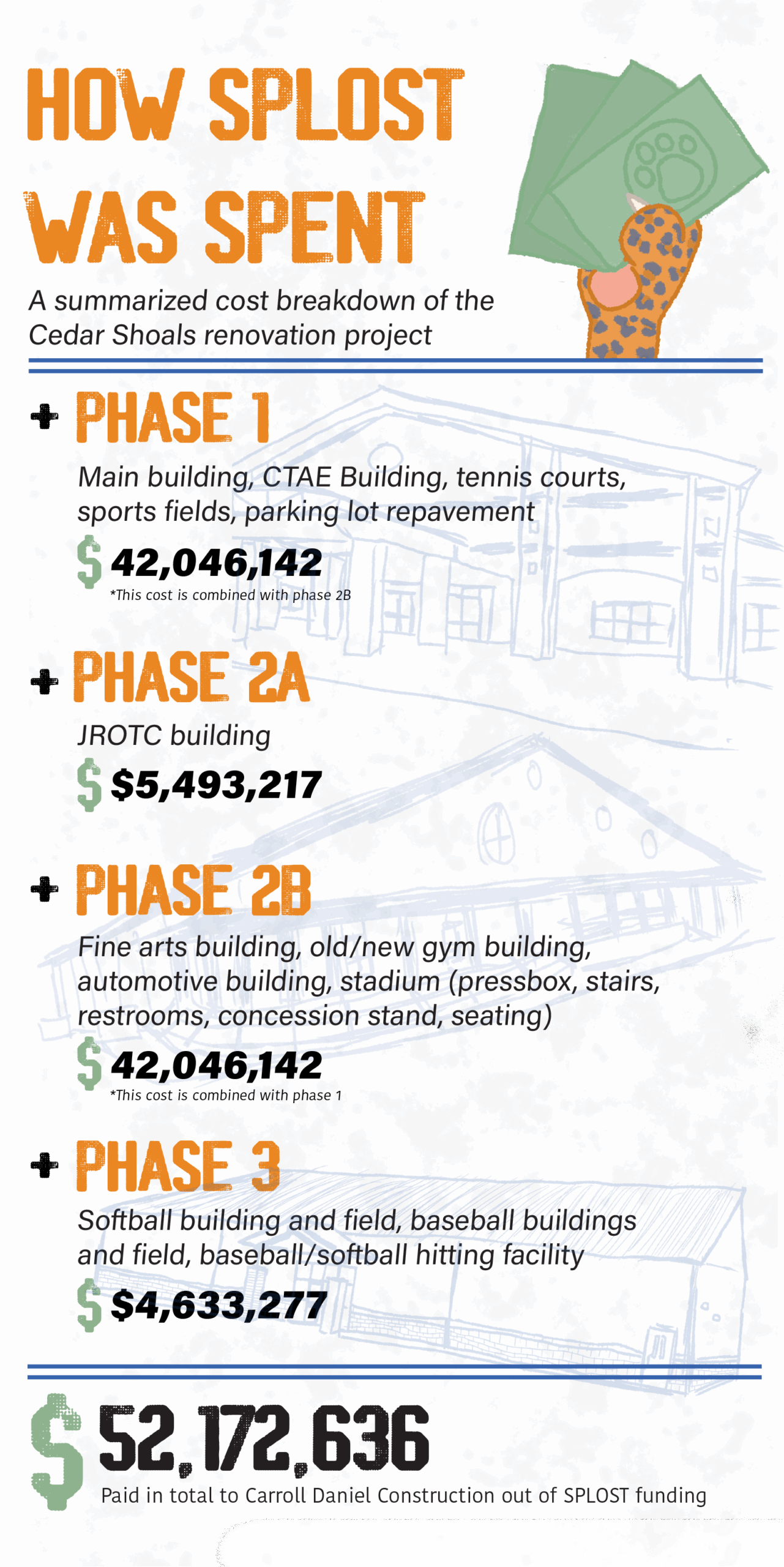
The Special Local Option Sales Tax (SPLOST) is a voter-approved one-cent tax sourced from the sales tax in each Georgia county that is then designated for a specific purpose. Clarke County’s sales tax is eight cents per dollar: five of those are standard sales tax, one is for the county, one is for transportation, and the last goes to education, which is the E-SPLOST fund. With around 30% of E-SPLOST fund used on things inside of the building, the remaining cut of the fund is designated for larger projects, such as renovation and construction.
“All of the laptops students get, that comes from SPLOST money. All the network infrastructure, all the projectors, teacher laptops, all that comes from SPLOST. Buses are bought with SPLOST. Some of the nutrition stuff in the kitchen is bought with SPLOST. Custodial, the cleaning machines that they ride, that’s SPLOST. But the bulk of it, probably 70% of it, goes to construction projects, renovating schools, replacing air conditioning and in this case major renovations,” Bassett said.
The desire to renovate was encouraged by more than the set schedule, with signs of aging beginning to show throughout the building. On the surface level, paint was chipping, ceiling tiles were stained, and the walls sported an outdated beige and brown color palette. Beyond the surface, teachers and students struggled with non-working bathrooms, finicky air conditioning systems and water leaks.
“The bottom floor (of Cedar) sits in a hole. And so when you get a ton of rain water on an old building, (the water) is going to find a way. Some of the bottom level classrooms in the past, they’ve had to come in before and do mold mitigation and that kind of thing because it would be leaking from a spot,” social studies department chair James Page said.
The renovation was needed for practical reasons, but it doubles as a refresh for school pride.
“I believe the students they go around, they have friends, they may have little siblings who go to other schools. And if they walk into Hilsman, which obviously is a brand new, multi-million dollar building that has all these nice things and new furniture, and then come over here and Cedar looks 25 years old with paint peeling off the wall … What that says is, or at least it can be internalized as, ‘they don’t value us,’” Page said.
Noticeable improvements of the renovation include new paint, the addition of murals, and removing old lockers to make room for more trophy cases. The flooring was customized to better match Cedar’s school colors, and the fine arts building had specialty tiling installed that represents their subject area. Currently, the main academic building sits mostly light grey, but there are plans to add branding around the school with more murals and graphics, with some already applied in the cafeteria and the end of each hallway.
“Think about it in the sense of like advertising or propaganda in a way. If you’re seeing images of the jaguar and ‘Cedar Shoals’ written and you’re seeing the school colors, that says school pride. Plain just white walls, or walls with old paint that’s chipping, says kind of the exact opposite,” Page said.
After the cosmetic additions, safety features were next on the list. The number of cameras were doubled, and a new intercom/doorbell system was added to the outside doors of the fine arts and CTAE buildings.
“I think with the new resources, with the new lighting, with the new furniture and with the different safety measures that are coming, I think it’s just going to provide an opportunity for the students to be more comfortable where they’re at,” Associate Principal of Operations Nathan Reincheld said.
Before initiating the renovation, the SPLOST team engaged an architect and organized local building committee meetings, in which students, parents and any community member who was interested could share ideas. The E-SPLOST team held a total of six public meetings and later held a private meeting for each department to specialize specific needs.
“We have a local building committee, which is students, parents, staff and anybody that wants to come to it, to kind of help with the planning of what we’re going to do,” Bassett said. “And then we’ll have six meetings to kind of go over furniture, finishes like carpet, paint, ceilings, lights and then the architect takes all of what they say in these meetings and then designs the project from there.”
“We have a local building committee, which is students, parents, staff and anybody that wants to come to it, to kind of help with the planning of what we’re going to do,” Bassett said. “And then we’ll have six meetings to kind of go over furniture, finishes like carpet, paint, ceilings, lights and then the architect takes all of what they say in these meetings and then designs the project from there.”
Rosemary Milsap, theater teacher, attended one of the committee meetings in February of 2024, worried that fine arts wouldn’t receive the same amount of care as other departments.
“I really was alarmed that when they were talking about, for instance, the gym, they literally had the equivalent of two pages of a table with all kinds of very specific things listed. And then when it talked about fine arts, it was a one sentence: fine arts improvement’” Milsap said. “I took that as my cue to say, ‘let’s not wait around.’ I got with the (fine arts) department and we got it rolling, and (the E-SPLOST team) pretty shortly had about two pages of information from us.”
Being the theater teacher since 1996, Milsap was more than present during the first renovation with a large hand in the planning process for the fine arts building. She spent over 100 hours conducting research and sitting in meetings with the administration and community theater design professionals, and she regards the entire process as one of her best career accomplishments. But as a young teacher with little experience in construction, she found that there were some design choices she vouched for in 2001 that didn’t hold up, such as gender specific dressing rooms and the wheelchair lift located in the auditorium.
“I wanted to make sure, this time around, that the fine arts building has proper ADA accommodation. I have watched in the 20 years that this building has existed, wheelchair users struggle to actually have access to the theatre space and the lobby space for ceremonies, performances and events,” Milsap said. “There had been a wheelchair lift that never got used because it was not practical for a wheelchair user. Would you want to have a whole audience sit there and watch you (lift for three minutes)? It was not designed with ease of use in mind.”
“All of the laptops students get, that comes from SPLOST money. All the network infrastructure, all the projectors, teacher laptops, all that comes from SPLOST. Buses are bought with SPLOST. Some of the nutrition stuff in the kitchen is bought with SPLOST. Custodial, the cleaning machines that they ride, that’s SPLOST. But the bulk of it, probably 70% of it, goes to construction projects, renovating schools, replacing air conditioning and in this case major renovations,”
After her experience during the first renovation and observing the struggles with communication, Milsap appreciates the efforts in communication by the E-SPLOST team and contractors working on the project.
“They’ve done a great job this time around, as far as doing better than what we did the last time. The liaison between what goes on with the construction and the school, Troy Bassett, he’s been really good about communicating. I can literally text him or e-mail him and he’ll get back in touch with me,” Milsap said.
Personnel changes also complicated the renovation process. When former principal Antonio Derricotte resigned in 2024, other administrators who were present during the beginning of the process also left, leaving little to no overlap.
“The weird thing here is the entire administration that was here during (the beginning of planning) all left before we really started,” Bassett said.
The shift in administration contributed to some delays,including the recommendation to install the new wall in the front office by dividing it into a section for parents and another for students, requiring six sets of new security doors in the main office area alone.
“With the new administration and the new requests, they were last minute things, and the construction people don’t work quite that fast,” Bassett said.
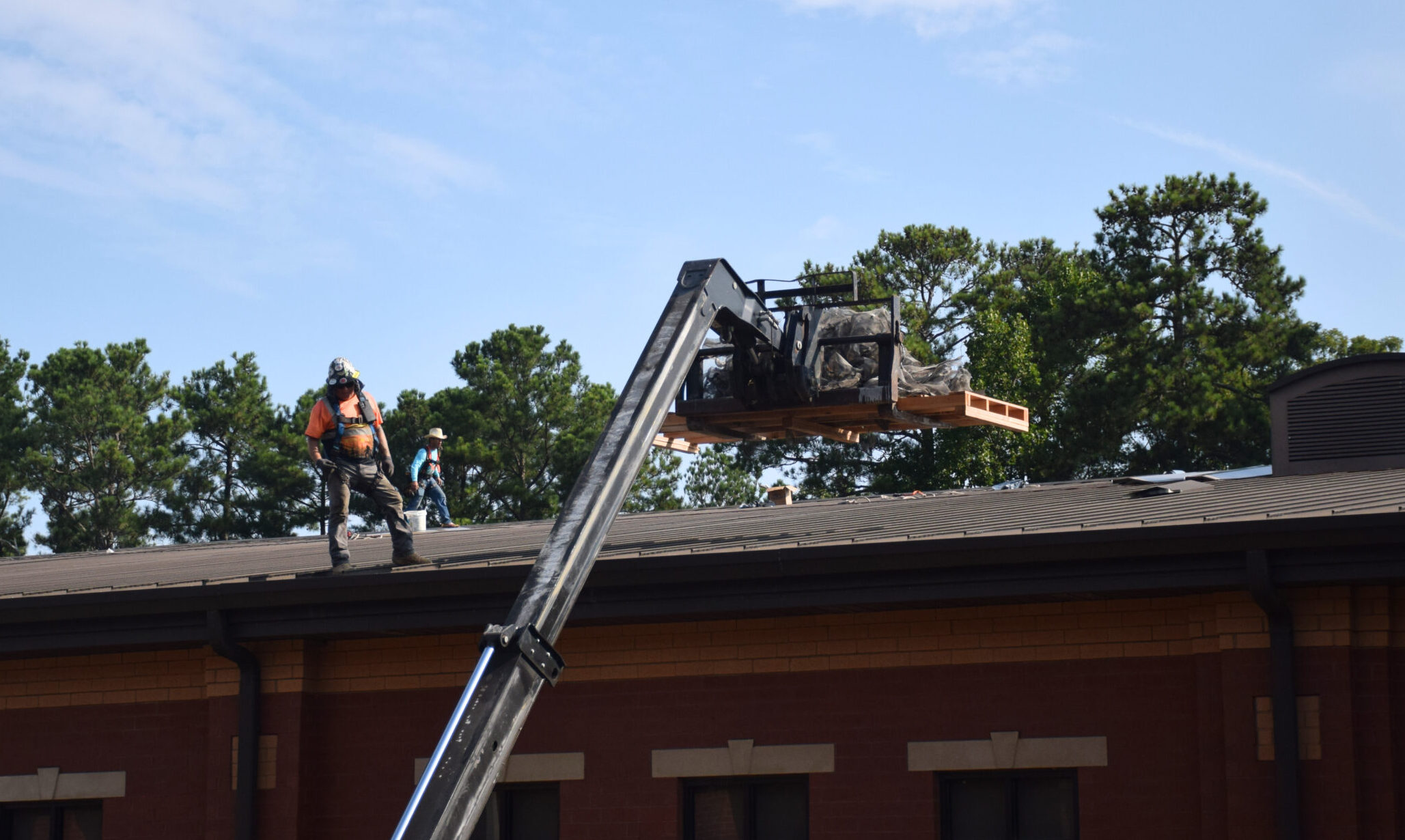
Despite setbacks, the process is steadily progressing toward completion, with plans to be finished this winter.
“I think we’re also going to have some work possibly done through December, and then hopefully by Jan. 1 it’s going to look like we don’t have any construction guys around,” Reincheld said.
As the renovation wraps up, the Cedar Shoals’ community looks forward to what these improvements will mean in the long term.
“Clarke County is providing us spaces that give real opportunities to our students. And at the end of the day, I just have to take a deep breath (and think) we survived through the construction mess. This space is only going to better serve our students,” Milsap said.
Ultimately, Cedar Shoals’ renovation has been a community effort built on persistence, collaboration and communication.
“It’s been a great team effort. E-SPLOST has done a great job of putting their effort into our school and into our entire campus, and I know we’re appreciative of what they’re doing,” Reincheld said.


