Cultivating a career: UGA Young Dawgs internship program gives students in-field experiences
The University of Georgia’s Department of Human Resources leads an internship program called Young Dawgs that gives high school students from the Athens area real life work experiences. Through this program, students can get involved in projects ranging from parasitic disease study to bacterial experiments that introduce them to college and possible future careers.
Stephanie Emegwam, a senior at Cedar Shoals High School, has been part of the program since the fall semester of 2024.
“From this program I get life experience to figure out what my future career might be, something that normal high school doesn’t always do,” Emegwam said.
After working with the Big Buddy program in Louisiana that focuses on mentoring underprivileged youth, James Geiser, the Director of Young Dawgs, moved to Georgia. Geiser has worked with Young Dawgs since its start in 2008.
“The Young Dawgs program is designed to give high school students a chance to have real experiences in a college. Not just where they come in and sit down, but where they actually participate and do real things,” Geiser said.
The primary requirements to be considered for acceptance are a minimum 3.7 GPA and the ability to get to UGA’s campus during the school day. Interested students can reach out to the program directly or discuss their interest with their school counselor.
“Although it seems like the requirements aren’t a lot, we really look for the commitment that the students express for the program,” Geiser said.
After applying and being accepted into the program, students are assigned to a mentor in the student’s field of interest. At the end of the semester students present their projects one at a time, sharing what they have been learning that semester with peers, faculty and parents.
CSHS senior Parker Lynch started Young Dawgs during fall 2025 with Dr. Micheal Yabsley researching wildlife disease. Being interested in wildlife prompted him to start looking at diseases that can transfer from animals to humans. He is specifically researching parasites that spread diseases, working alongside the Southeast Wildlife Cooperation and Disease Study.
“This experience is giving me hands on learning experience that gets me to work with professors and some graduate students on their projects,” Lynch said. “I also get to work with different animals like ticks, slugs, snails, freshwater mussels and reptiles which is something new for me.”
When Young Dawgs research projects are presented, questions are welcome at the end of the presentation, and the students’ professors get to see their students’ work all in one place.
These 8-12 minute long presentations help students practice public speaking and presentation skills. Geiser holds small meetings with the students to receive feedback for improvement before presenting in front of a crowd.
“One of their main criteria they are judged upon is that their presentation can’t be boring. I help them refine their presentations to show what they have done with their projects rather than just giving us a speech,” Geiser said. “I go through what could make them better and what the next steps are.”
“The Young Dawgs program is designed to give high school students a
chanceto have real experiences in a college, not just where they come in
and sit down, but where they actually participate
and do real things,”
Amy Medlock, biochemistry and molecular biology professor and Emegwam’s mentor, either assigns projects to students or lets them choose a topic that they are interested in researching based on their experience with lab research. This has led to a few of her students being creative with their presentations.
“I had someone sing a song, make a clay module, and one student created her project to resemble a recipe,” Medlock said.
Emegwam learned about the Young Dawgs program through her sister who was working in a science lab at UGA. When she learned of a Young Dawgs student who was working alongside her, Emegwam’s sister decided to mention it.
“After my sister told me about that student I looked into who the program director was, emailed him, talked to my counselor, and worked hard to get into the program,” Emegwam said. “There were a lot of logistics that I had to figure out.”
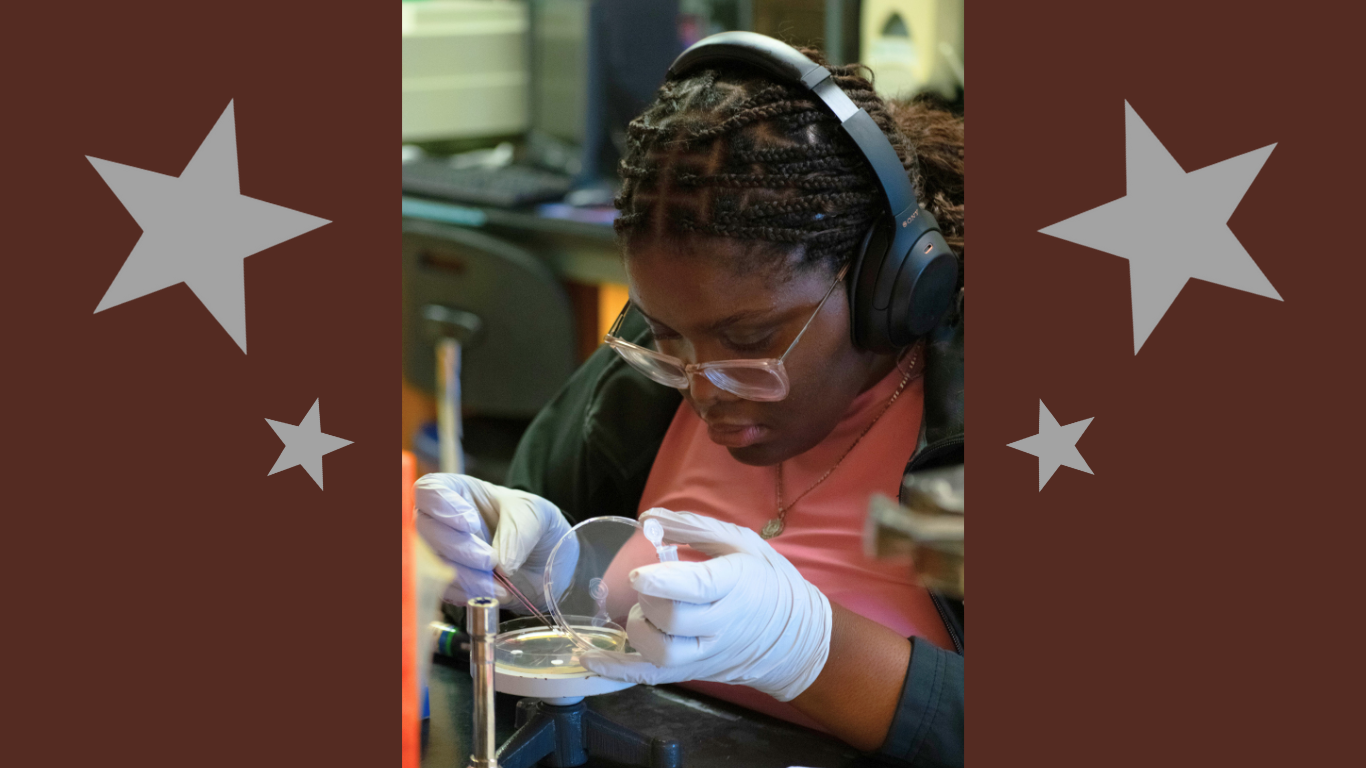
After applying, Emegwam met with Geiser and eventually paired with Medlock as her mentor. In the fall semester of her junior year Emegwam started working with coproporphyrin, a chemical compound that assists with oxygen transport in blood. Through this experience, she felt some freedom that she didn’t previously have in school.
“I really love the independence that my professor gives me. I never imagined that as a junior last year I would be able to be in a lab with all this expensive equipment and being trusted to know what I’m doing,” Emegwam said.
Emegwam is now in her second semester of Young Dawgs, still experimenting with biochemistry by furthering her research with coproporphyrin.
“She works super independently and I don’t doubt that she’ll win a prize for best presentation like she did last year. She really knows how to distill the story of her research down and explain it so that everyone can understand,” Medlock said.
Working with students in her lab since 2013 after Geiser reached out to her to mentor a student, Medlock enjoys working with high school students and still connects with graduates.
“I’ve stayed in touch with many of my Young Dawgs students and follow them through college into graduate school,” Medlock said. “Young Dawgs is also a different experience than dual enrollment and you get a lot more one-on-one with the faculty that helps grow more personal relationships.”
Lynch enjoys the hands on experience that Young Dawgs offers and how working with professors and graduate students gives him a different experience than high school does.
“I like that I’m getting to do something in a field I eventually want to work in instead of the usual academics,” Lynch said. “Although I sometimes need help with the equipment I’m using I can usually do a lot of the identification of the parasites by myself.”
Emegwam finds that although Young Dawgs is exciting, there are also certain expectations to uphold. As each week presents a different schedule for her, Emegwam finds that managing time has become more important.
“I have to go to UGA, and get through all of the traffic to find parking after I’m done with my classes at Cedar,” Emegwam said. “I often get to the lab late because of this and facing a changing schedule means I have to be dynamic with planning.”
During her first semester with Young Dawgs her time in the lab was recorded as an internship in her high school transcript. Now it is listed as credit for work-based learning (WBL). For each of the spring and fall semesters there is a required amount of 7-8 hours that the students have to complete in the lab. For Emegwam’s WBL credit, she has to track at least 23.4 hours per month.
“I have to get forms signed by my mentor to say that I have been there and doing the work before turning it in into the WBL coordinator at my high school,” Emegwam said.
UGA hosts a Young Dawgs summer program as well but it is mostly for students who are not in town. This summer semester only holds spots for 10 students and requires that they have 15 to 20 hours a week working on campus. This semester does not offer high school credit like the spring and fall semesters do.
“For the summer program we get a lot of students from Atlanta who commute each day they have to come in for their hours,” Geiser said. “But students do it for the experience despite the distance.”
In past years Young Dawgs has mainly been prevalent at other schools in the area but Emegwam hopes more CSHS students will reach out and apply.
“Because I was the only student from Cedar to participate in Young Dawgs last year I’m just hoping that others take advantage of the same experience,” Emegwam said.