Jaded stomping grounds: The East side is growing, but where can we gather?
My whole life I’ve lived in a rural area, far away from my friends, and even further away from places where we can hang out. It’s isolating to live further away, and I don’t have neighbors, or even kids my age, nearby.
When I was younger, I envied kids on television shows who lived close to their best friends. In the Netflix series “Alexa and Katie,” the main characters’ rooms were connected by a bridge on a tree. Those close neighborhoods fostered strong relationships. Characters could walk into town without the slightest difficulty.
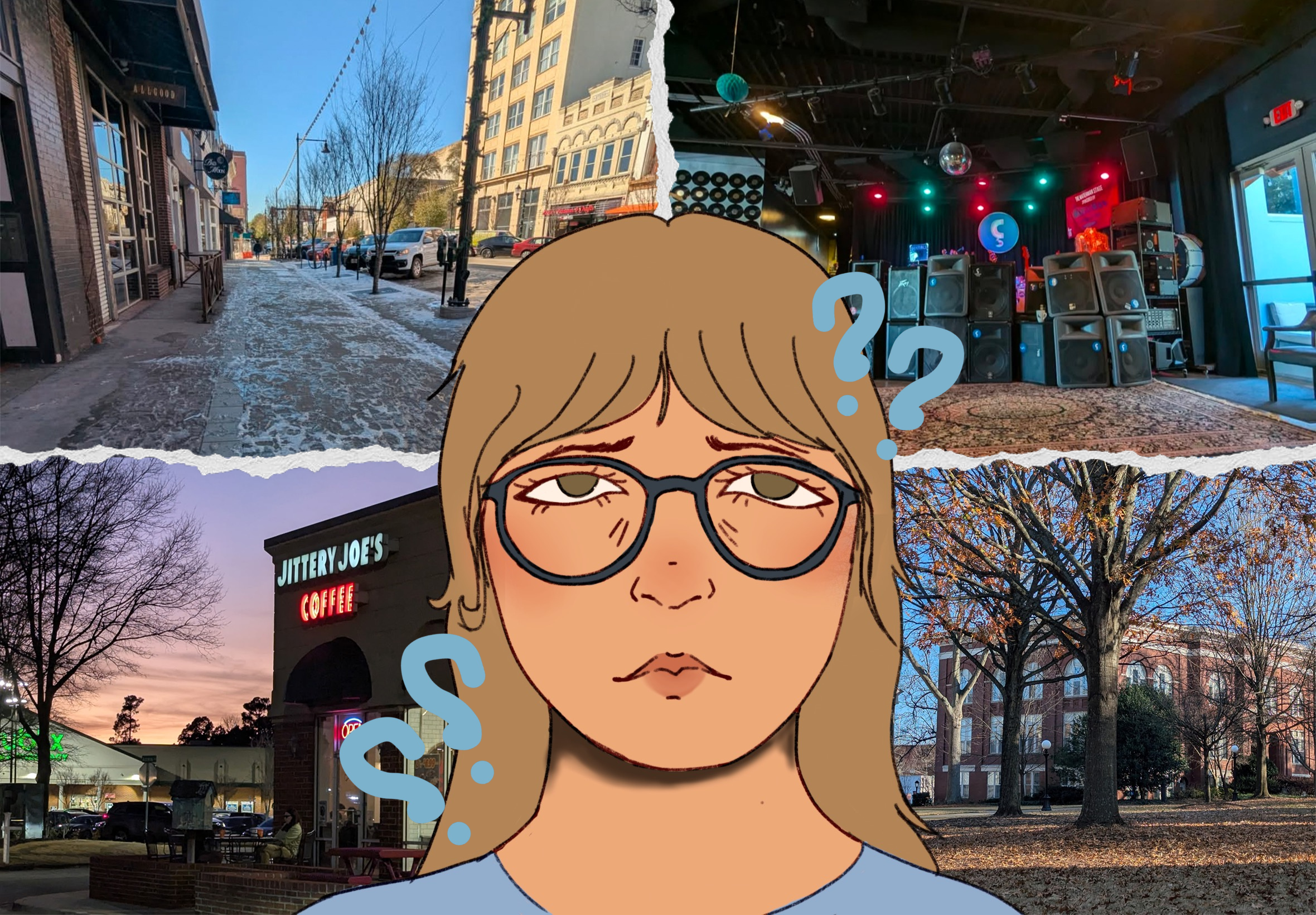
Though I may occasionally cross paths with a friend while shopping or running errands, I crave those casual opportunities to connect. Without these chances, it is almost natural to feel isolated, even when you are surrounded by people. On the East side of Athens, there are limited public areas that encourage this kind of everyday interaction, an example being Jittery Joe’s and Cali N Tito’s. However these few locations require money to be spent. Not every social gathering needs to be a big event; sometimes people just want a comfortable place to talk or relax.
While downtown Athens offers plenty of those options, the East side lacks the same variety. This imbalance means that residents must drive across town to find a sense of community, which can feel inconvenient.
Adding to the problem, there has been a rise in investment in the Athens community. An example of this is the $36 million investment towards Kroger Marketplace, which resulted in the demolition of businesses such as Blind Pig Tavern and Sally’s beauty supply store to build a fourth gas station at the intersection of College Station Rd. and Barnett Shoals Rd.
With buildings being demolished, the spaces on the East side that could be considered ‘walkable’ are slowly disappearing, leaving fewer opportunities where people naturally run into each other. The addition of more parking lots signals prioritizing cars over conversation.
These third spaces that foster a sense of connection allow people to see each other outside at local parks or nearby gathering spots. These spaces are scarce. If my friends and I want to hang out without spending money, we are left with parking lots, someone’s driveway or a drive across town. There isn’t a central plaza or indoor space where teenagers can come and go as they please.
The scarcity in physical venues have inspired me to find creative activities and locations when making plans with friends. Traveling 20 minutes downtown to wander the same five stores became an unnecessary habit. Instead, we began having picnics on North Campus and the intramural fields. I found joy in places I would have overlooked. Unfortunately, these locations still require a 20 minute drive.
On the East side, locally owned Jittery Joe’s became an essential place for study sessions, catchups and meetings. We sit there for hours, cautious not to overstay our welcome, extending a single purchase into an afternoon. Jittery Joe’s remains one of the only places that feels designed for lingering.
In between the long drives and improvised plans, I realized the place was never the most important part. None of them were outstanding on their own. I was depending less on the space and more on the people. What made them matter to me was who I was surrounded by, because when the conversation was good, the space ultimately faded into the background.
That doesn’t mean physical spaces are irrelevant. An area’s design shapes how connection happens. As more housing and commercial projects rise on the East side, city leaders and developers have an opportunity to include sidewalks, benches, small parks and gathering areas in their plans.
The new East side Athens Library could become one of the few free indoor spaces for young people. But those spaces need to be intentionally designed to encourage interaction, not just fill a blank on a map. Growth is not inherently bad. Investment can revitalize neighborhoods and provide needed resources.
If the East side continues to expand without creating places for people to gather, it risks becoming a collection of buildings instead of a connected community. I’ve learned that while places can make connections easier, they don’t create it on their own. A community isn’t built by gas stations or grocery stores. Rather, it’s built by the people willing to show up for one another, wherever they can find the space.