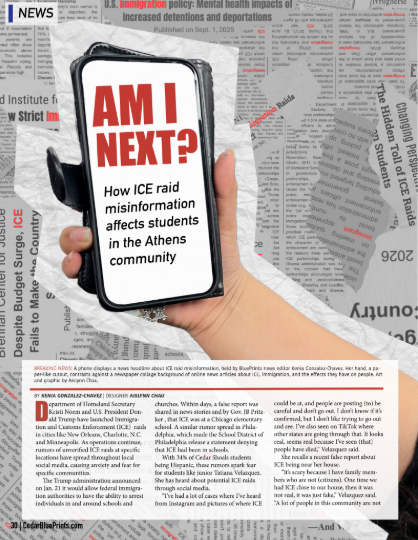
Am I next? How ICE raid misinformation affects students
Former Department of Homeland Security Secretary Kristi Noem and U.S. President Donald Trump have launched Immigration and Customs Enforcement (ICE) raids in cities like New Orleans, Charlotte, N.C. and Minneapolis. As operations continue, rumors of unverified ICE raids at specific locations have spread throughout local social media, causing anxiety and fear for specific communities.
The Trump administration announced on Jan. 21 it would allow federal immigration authorities to have the ability to arrest individuals in and around schools and churches. Within days, a false report was shared in news stories and by Gov. JB Pritzker, that ICE was at a Chicago elementary school. A similar rumor spread in Philadelphia, which made the School District of Philadelphia release a statement denying that ICE had been in schools.
With 34% of Cedar Shoals students being Hispanic, these rumors spark fear for students like junior Tatiana Velazquez. She has heard about potential ICE raids through social media.
“I’ve had a lot of cases where I’ve heard from Instagram and pictures of where ICE could be at, and people are posting (to) be careful and don’t go out. I don’t know if it’s confirmed, but I don’t like trying to go out and see. I’ve also seen on TikTok where other states are going through that. It looks real, seems real because I’ve seen (that) people have died,” Velazquez said.
She recalls a recent false report about ICE being near her house.
“It’s scary because I have family members who are not (citizens). One time we had ICE close to our house, then it was not real, it was just fake,” Velazquez said. “A lot of people in this community are not citizens.”
A study by J. Jacob Kirksey and Carolyn Sattin-Bajaj in November of 2023 concluded that student absences increased following a large worksite ICE raid in Sumner, Texas. In addition, the study found that reading and math test scores declined and a significant number of Latinx and English learner students left their school district.
While many reports are false alarms, the reports of ICE presence in the community are disrupting daily life such as student attendance and medical visits.
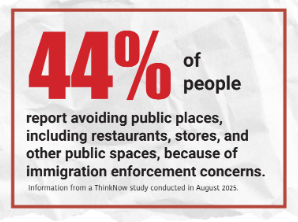
“We have seen a huge increase in attendance issues. Attendance was already a struggle, but especially with our Latinx students we see more attendance concerns. Maybe (students) are the ones that are driving for the family because they have a license and their parents maybe are undocumented and can’t be driving, or just the fear if there are reports in that community that they’re out,” counseling department chair Monica Quinones said. “Even just like seeking help, whether it’s medical visits or any other sort of support, there is a level of fear that creates a barrier to reaching out for support out of fear of deportation or just from ICE presence.”
Quinones recognizes that seeing the media spread unverified reports can cause lasting fear and uncertainty in the community, even if it’s not accurate information.
“It’s alarming and striking to see, especially like the TV reports or messages. I think it’s going to be something that stays with the community for a long time, just the level of fear and not knowing. Even if it’s not accurate information, just the unknown and the possibility is very scary,” Quinones said.
Kelly Medina is a community organizer and is the Community Outreach Coordinator for U-Lead Athens, a non-profit organization dedicated to providing equal higher education to students. Medina highlights the fear associated with seeing online news about ICE raids, as they often lack announcements or clear signs.
“In Athens, there have been some ICE sightings around the community and there have been unfortunately a few raids around the state of Georgia. Even though ICE raids might not specifically be happening here in Athens, it can still be super scary and stressful for someone because you don’t know if it could happen here, especially if you’re seeing so many things in the news,” Medina said.
Remembering her own personal experiences, Medina recalls her own fear and worry about the safety of her parents as a middle school student growing up.
“You might be a citizen, you might be a resident, whatever the case may be. A lot of students here, their parents are undocumented. Your parents might not make it home from work, your parents might not come back when you go to school,” Medina said. “I remember feeling exactly like that. When I was in middle school when there were raids happening here in Athens, I was scared every single day.”
“It’s important that at a school like (Cedar Shoals) that students feel like teachers understand where they’re coming from, are understanding, and can point them in the direction of resources to help them. It’s bleeding into your parents’ lives or into your siblings. Nobody comes to school in a vacuum. You come, bringing your life,”
The Athens Immigrant Rights Coalition (AIRC) is a collection of nonprofit organizations with a committee called The Rapid Response Team (RRT) that monitors reports from community members regarding ICE sightings and police activities that could potentially impact undocumented communities. In 2025, RRT responded to 82 reports.
“Many of (these reports) could have been false, but it is not always clear if the misinformation is intentional like trolls or if there are suspicions of sightings that turn out to be not ICE, or even police activity,” RRT coordinator Adehlheid Schmidt said.
It’s normal for people to be on high alert and report anything that seems suspicious, Schmidt says. However, public posts on social media claiming ICE activity often turn out to be misinformation, since most people don’t have a way to verify what they’re seeing.
“I think it is very common for folks to be on high alert and see something that looks off and report it. We do want them to report these incidents, even if they are unsure,” Schmidt said.
She emphasizes that reports should be sent directly to organizations like AIRC so they can quickly investigate whether it’s actually ICE, local police, or something unrelated as spreading unverified information about ICE can create uncertainty and fear.
“These reports are often misinformation because the person posting it doesn’t know how to confirm if that is true. Ideally, these reports come to us, and then we respond and mobilize to verify if the report is actually ICE or police activity or something else entirely, at which point, we can inform the community. But blanket statements about ICE when you don’t know can have a negative impact on the targeted community,” Schmidt said.
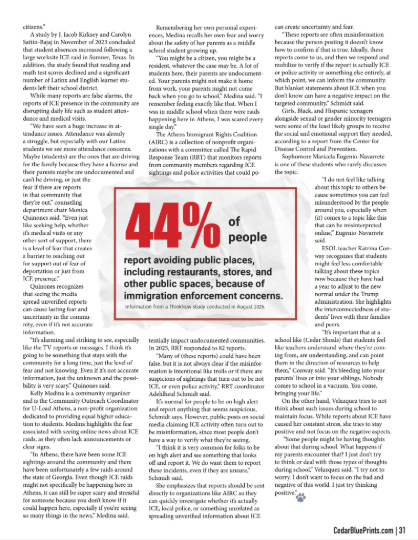
Layout by Aislynn Chau. Featured in MARCH 2026 | VOLUME XXVI, ISSUE 2.
Girls, Black, and Hispanic teenagers alongside sexual or gender minority teenagers were some of the least likely groups to receive the social and emotional support they needed, according to a report from the Center for Disease Control and Prevention.
Sophomore Maricela Eugenio-Navarrete is one of these students who rarely discusses the topic.
“I do not feel like talking about this topic to others because sometimes you can feel misunderstood by the people around you, especially when (it) comes to a topic like this that can be misinterpreted online,” Eugenio-Navarrete said.
ESOL teacher Katrina Conway recognizes that students might feel less comfortable talking about these topics now because they have had a year to adjust to the new normal under the Trump administration. She highlights the interconnectedness of students’ lives with their families and peers.
“It’s important that at a school like (Cedar Shoals) that students feel like teachers understand where they’re coming from, are understanding, and can point them in the direction of resources to help them,” Conway said. “It’s bleeding into your parents’ lives or into your siblings. Nobody comes to school in a vacuum. You come, bringing your life.”
On the other hand, Velazquez tries to not think about such issues during school to maintain focus. While reports about ICE have caused her constant stress, she tries to stay positive and not focus on the negative aspects.
“Some people might be having thoughts about that during school. What happens if my parents encounter that? I just don’t try to think or deal with those types of thoughts during school,” Velazquez said. “I try not to worry. I don’t want to focus on the bad and negative of this world. I just try thinking positive.”