Witness a night of ‘Withdrawal’: filmmaker Aaron Strand paints a picture of addiction
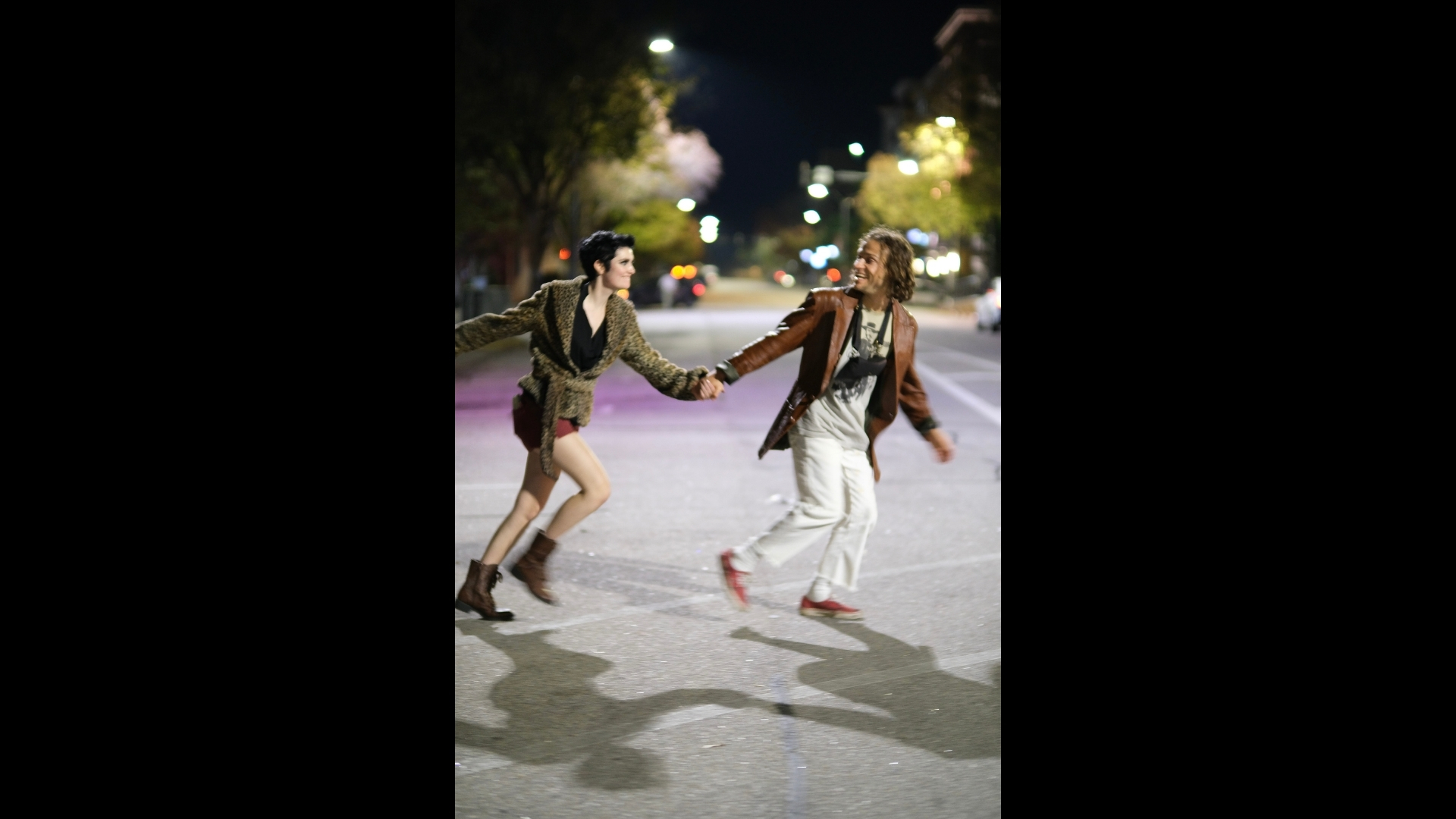
The micro-budget feature film directed, written and produced by Athens local Aaron Strand, opens with Jay giving Vivian a guitar with paint on it, which the viewer later learns is what Jay did for a living when they first met. Jay’s art stays a constant addition throughout the film, as it is used in timestamp scenes throughout the couple’s night of withdrawal and in the opening credits.
“Withdrawal” follows the artistic couple of Jay (Brent Michal) and Vivian (Millie Rose Evans) as they experience withdrawal from opioids. The audience follows the couple through a series of emotional flashbacks alongside the main story that provide context around the leading couple. Flashbacks reveal Vivian’s and Jay’s past, some humanizing the pair who are otherwise portrayed in bad light due to the effects of addiction.
After nearly three years in production, the feature film “Withdrawal” debuted, winning awards such as the Okreel Best Feature Film award in Athens and the Best Georgia Film at the Rome International Film Festival.
Most of the movie was shot on a Sony FX1 camcorder from 1999, as Strand was heavily inspired by filmmakers from the late ‘90s and early 2000s who were part of Dogme 95: a Danish film movement that focused on stripping away things like special effects, artificial lighting or music that doesn’t exist in the scene. Strand felt eliminating those elements from “Withdrawal” would help viewers experience more emotion and closeness to the story and feelings.
“Mini DV tape has this incredible quality of a home movie, which I find both at once incredibly intimate and yet also strangely alienating. When you watch someone’s Christmas home movies from 2001, it’s like you’re sort of there, but it’s also sort of a dream state. That’s the emotional experience of being on heroin. (The tape) carries all that grit, the noisy shadows and the texture, it’s tactile. It also lends itself to the type of editing that I knew I wanted to do, which was very chaotic. I wanted it to feel like a train that’s teetering off the track,” Strand said.
Throughout the film, parallels exist between what happens in the present and a memory from a similar situation or location. For example, in one of the worst hours of withdrawal, Vivian lays on the ground weakly playing the guitar while scenes of earlier years overlap where she happily plays the same song. The song she plays is called “Portugal,” which follows themes of Vivian’s feelings of separation from her parents, as Vivian wants to have a stronger connection with them.
Athens musicians such as Squallé are credited with all of the film’s music including all of the music that Vivian plays or performs that was written by her actress Millie Rose Evans, who grew up doing theatre and acting in the Athens-area. Evans composed the songs written for Vivian in character to fit the specific scene the song would be played in.
“(I wrote ‘Portugal’) to give some backstory on her. Where did she come from and why might she decide to do drugs? Could she have felt some isolation? The other song that she plays when she’s high and performing on stage is called ‘How did it come to this?’ That song is just talking about the dread, the euphoria, the ups and the downs and falling in love, but it’s also just being like, ‘How the hell did I end up here?’” Evans said.
Strand’s past experience with opioids and his path to sobriety inspired the story in “Withdrawal.” The idea of telling a story following the struggles of sobriety has always been with him, following the fallout of another project Strand felt that he saw the story very clearly in his head and knew he needed to act on it.
“I knew I had to go back to square one. It was just one of those moments where I just knew I saw the beginning, the middle and the end of the story so clearly that I had the confidence to proceed and proceed with a kind of reckless abandon,” Strand said.
Strand encountered difficulties in producing a micro-budget film. Although there was money set aside the cast and production found the small amount of money at hand difficult to work with. The team found ways around the budget, turning to a more local starting point. Strand used places around Athens as the set, including Flicker Bar, the Firefly Trail bridge and a multitude of downtown businesses appearing in the background.
“I had to make something that was treatable. I had to have something that was contained in its locations and would fit within the budget that I had. I’m really grateful for this town that has been there for me time and time again. It was the incubator. (Athens) was the space that I needed, but it gave me the time and space to experiment with this art form that is so important to me. That experience is something that I want to share over and over again with this town,” Strand said.
“Everybody knows somebody who knows somebody who has been impacted by addiction in some way. It’s a conversation that a lot of people don’t want to talk about because, yes, it’s uncomfortable, but it needs to be talked about because that’s how we can heal, connect and grow. The root of most addictions is loneliness and isolation and not feeling understood, so the only way that we can heal is to tell these stories. Who knows who is sitting in that theater and secretly has their own addiction or their own struggle. It doesn’t have to be heroin. So it’s just allowing people to feel seen,”
After premiering at the Atlanta Film Festival in late April of 2025 to an audience of over 400 people, “Withdrawal” appeared at 11 other festivals including the Athens Film Festival, the Macon Film Festival, the art of Brooklyn Film Festival and the Golden Isles Film Festival.
“It was sold out in the main huge auditorium, and everyone was laughing and everyone was crying, it was just so emotionally reactive,” Evans said. “On the other hand, I went to Japan and went to this film festival in Japan, and they have a different movie theater etiquette there, I didn’t know this. When the movie ended, nobody clapped when the credit started rolling and I was like, ‘oh my god, they hated it. This is insane,’ but as soon as the credits finished, everyone just started clapping. It’s just been a different experience everywhere.”
When Evans first started working on “Withdrawal,” she knew the importance of staying true to her character. Evans studied the mannerisms of a heroin addict, as she had never experienced it herself. Although intense, by coming up with systems and imagining what the impact of Vivian’s withdrawal was in that moment, Evans thinks she portrays the character accurately.
“Because this story is so personal to (Strand), we really had to nail the emotional beats and objectives of each scene. There were these moments of like beautiful epiphanies and brilliance that would happen because we were so in it.We didn’t have a working script until about ten days before shooting, we just knew what the scene was, and what the objectives were, so we just really immersed ourselves,” Evans said.
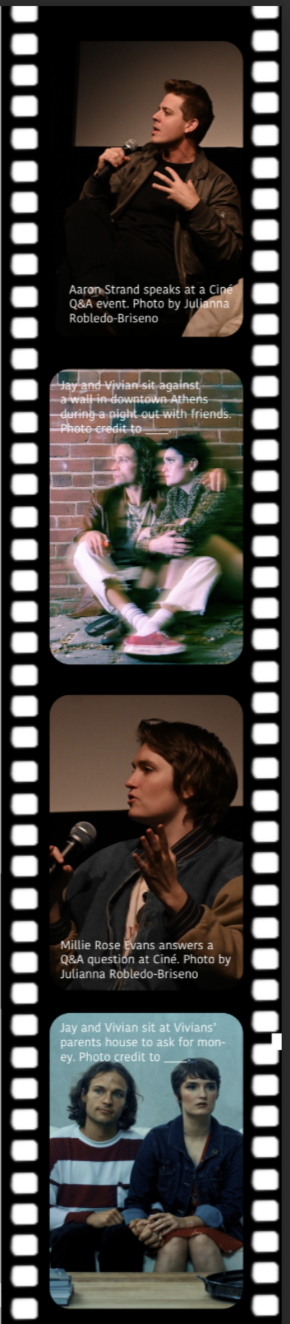
Athens movie theatre Ciné welcomed the Athens premier of Withdrawal from Feb. 6-12, with prominent locals hosting Q&A’s with Strand and other cast and crew. One of these hosts was Cedar Shoals social studies teacher Montu Miller who led a Q&A panel about the film.
“It’s the best way to look at the community. I mean, you got me in there, you got his film, and then you got Ciné, so it’s like this nice little vibe of community. So I thought it was dope. I think it falls right along with the independent music and independent art scene we have here. It’s just another element and another sector of Athens that we have,” Miller said.
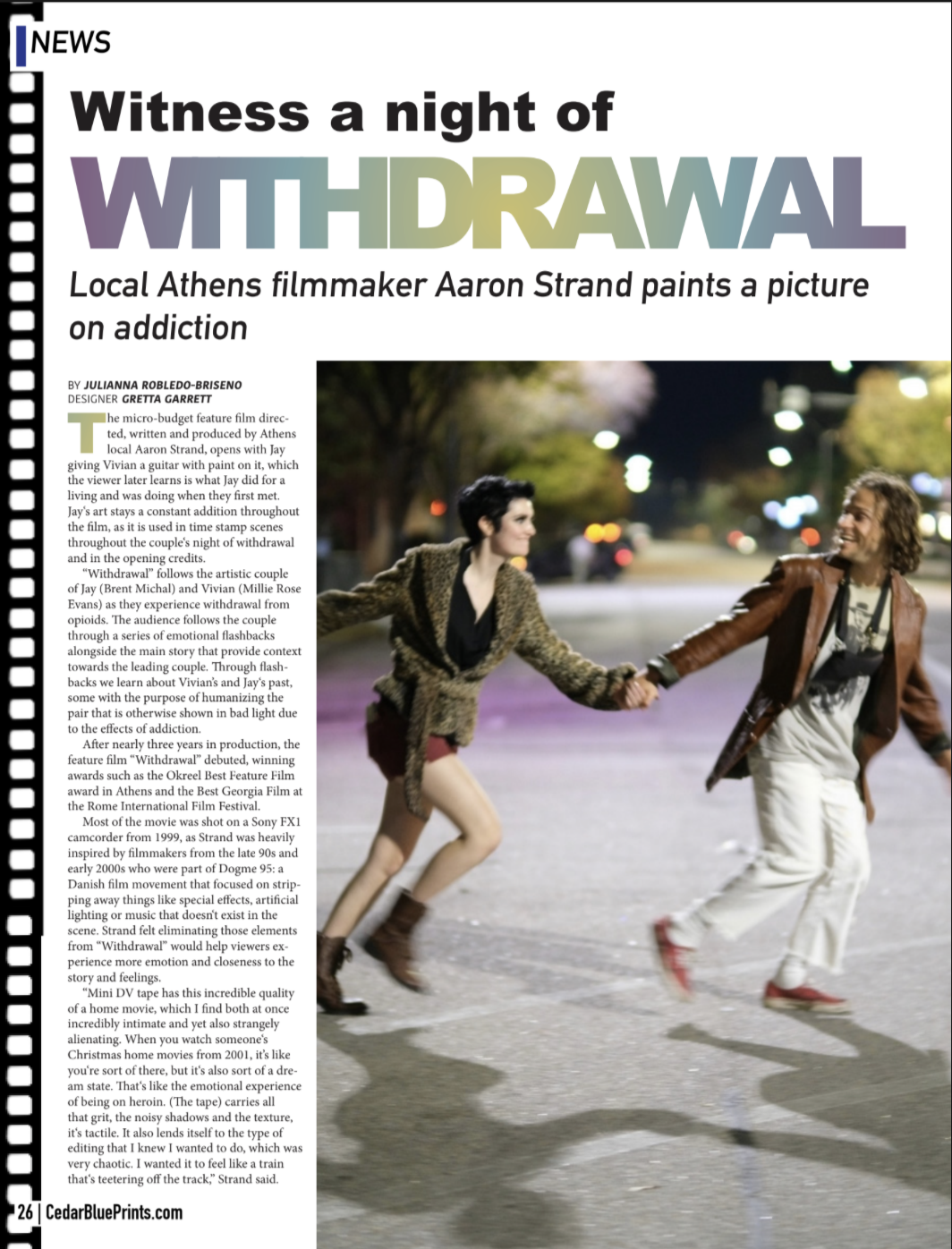
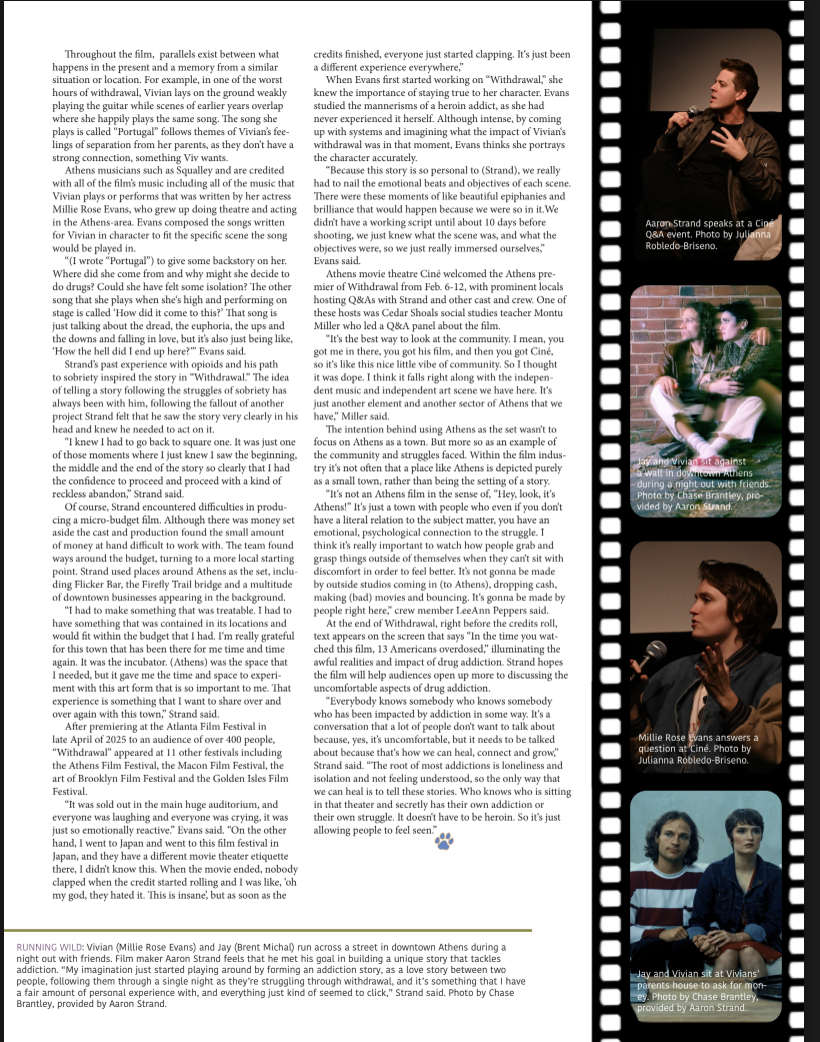
Magazine layout by Gretta Garrett.
The intention behind using Athens as the set wasn’t to focus on Athens as a town. But more so as an example of the community and struggles faced. Within the film industry it’s not often that a place like Athens is depicted purely as a small town, rather than being the setting of a story.
“It’s not an Athens film in the sense of, ‘Hey, look, it’s Athens!’ It’s just a town with people who even if you don’t have a literal relation to the subject matter, you have an emotional, psychological connection to the struggle. I think it’s really important to watch how people grab and grasp things outside of themselves when they can’t sit with discomfort in order to feel better. It’s not gonna be made by outside studios coming in (to Athens), dropping cash, making (bad) movies and bouncing. It’s gonna be made by people right here,” crew member LeeAnn Peppers said.
At the end of “Withdrawal,” right before the credits roll, text appears on the screen that says “in the time you watched this film, 13 Americans overdosed,” illuminating the realities and impact of drug addiction. Strand hopes the film will help audiences open up more to discussing the uncomfortable aspects of drug addiction.
“Everybody knows somebody who knows somebody who has been impacted by addiction in some way. It’s a conversation that a lot of people don’t want to talk about because, yes, it’s uncomfortable, but it needs to be talked about because that’s how we can heal, connect and grow,” Strand said. “The root of most addictions is loneliness and isolation and not feeling understood, so the only way that we can heal is to tell these stories. Who knows who is sitting in that theater and secretly has their own addiction or their own struggle. It doesn’t have to be heroin. So it’s just allowing people to feel seen.”