A disconnected generation: media literacy education is not where it needs to be
Teenagers have never trusted the media less. According to a 2025 study by the News Literacy Project, 84% of teens describe traditional media like newspapers and cable news negatively, with the most common descriptions being “fake” and “biased.” Additionally, nearly half said that journalists do more to harm democracy than to protect it.
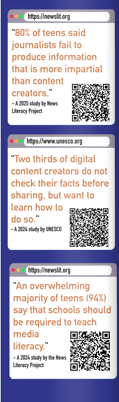
While a healthy skepticism of the media is important, these levels of distrust can lead to more misinformation. 80% of teens say that they believe that online content creators are more impartial than organized media. When teens turn away from the media, they often face greater misinformation online. News media is edited and fact checked before being published, while online creators typically operate independently without oversight. UNESCO found that nearly two-thirds of content creators do not conduct fact-checking before publishing materials.
A top feature of most social media platforms is the ability to quickly repost or reshare content, meaning that misinformation or biased reporting spreads through social circles like wildfire. This problem is especially magnified with today’s teens, who spend hours on social media daily.
Additionally, the proliferation of artificial intelligence has led to greater levels of misinformation online. The number of AI generated news sites grew from 49 in 2023 to over 2,000 as of October 2025 according to NewsGuard, with more likely being created since then. AI is highly inaccurate in news writing, with the BBC finding a 45% rate of major mistakes in reporting.
Being such an evolving topic, schools often fall short in teaching true media literacy. A 2024 study by the News Literacy Project reported that while 94% of teens thought that school should require media literacy education, only 39% received any. Not only does media literacy as a whole need to be taught, but education needs to be current. With the rise of AI news sources and information via social media, simply checking to see if a website’s URL contains “.org” or “.gov” is no longer an effective way to filter out all false news. However, with the already packed high school curriculums, there isn’t much time to dedicate to media literacy in regards to social media. Kids are also getting their own phones or tablets as soon as they can use them, making high school too late to start effectively teaching media literacy.
As student journalists, we receive the most education on media literacy. We only gain experience by reading articles, asking questions and discussing biases. Also, by writing our own articles, we learn how to distinguish what is trustworthy by putting it into our own writing. True media literacy is built with hands-on experience and group discussion that challenges ideas, and any easier way to go about teaching these vital skills just won’t stick. If elementary and middle schools implement a lighter version of this education consistently, the next generation will be encouraged to read professional media and better spot misinformation or poorly-reported news. They might even find their way back to actual news media.
The tools to start this push already exist. In 2024, the Center for Educational Equity published a framework on modern media literacy education intended for K-12 schools, and that is only one of the more detailed resources for educators. On their list of ways subtle media literacy education can be worked into any subject, they suggest doing “regular discussions of news stories, including comparisons from various sources, with analysis tools that reach deeper than identifying true/false or a left/right political perspective” during social studies, similar to what we do in class as student journalists.
Additional information about media literacy with nuanced topics such as AI are being published by organizations such as Media Literacy Now, whose resources for educators can be used to inspire lesson plans. In order to educate students about media literacy, educators need to understand media literacy as well, and online sources like Media Literacy Now and The National Association for Media Literacy Education (NAMLE) are great for staying up to date on media literacy legislation or nuances.
While school can push younger students to be more media literate, once they get older, it’s up to them to decide whether they apply the knowledge or not. With intentional education and practice of media literacy skills, more teens will think twice before reposting shock headlines and trust in traditional media can be restored.